

1941–2025::The Mars Flying Boats and Vancouver Island’s Pioneer Water Bomber Pilots

Updated: May 12
The aircraft and pilots who forever changed the way British Columbia’s forest fires were fought.

“1956::With Hula Girls, Speeches and Leis”
Newspaper clipping: Honolulu Advertiser (1960)
Honolulu, Hawaii
In 1956, Hawaii’s residents were informed that their beloved Martin Mars aircraft would be formally retired and possibly scrapped. The colossal flying boats, long a familiar sight in Hawaiian skies, had broken aviation records for the US Navy, transporting troops and cargo between California, Hawaii, and the South Pacific during the final days of the Second World War.

"1945::The Flight Path of the Mars Flying Boats in the South Pacific"
Map: Source unidentified (c. 1945)
In the years following the Second World War, the Mars aircraft continued to serve, safely flying more than 200,000 passengers and carrying over 20,000 tons of high-priority cargo across a distance equivalent to 23 round trips to the moon. For Hawaii’s residents, the departure of the Mars fleet marked a bittersweet end to a remarkable era.

“1956::The Marianas Mars Leaves Hawaii for the Last Time”
Photograph: U.S. Navy, Honolulu Star-Bulletin (1956)
Honolulu, Hawaii
With hula girls, speeches, and leis, a crowd gathered at the docks of Ke'ehi Lagoon to bid the Marianas Mars—the last of these old friends—a fond aloha. As the roar of its engines filled the air, the Marianas Mars flew overhead, bound for a new life on Vancouver Island, British Columbia.
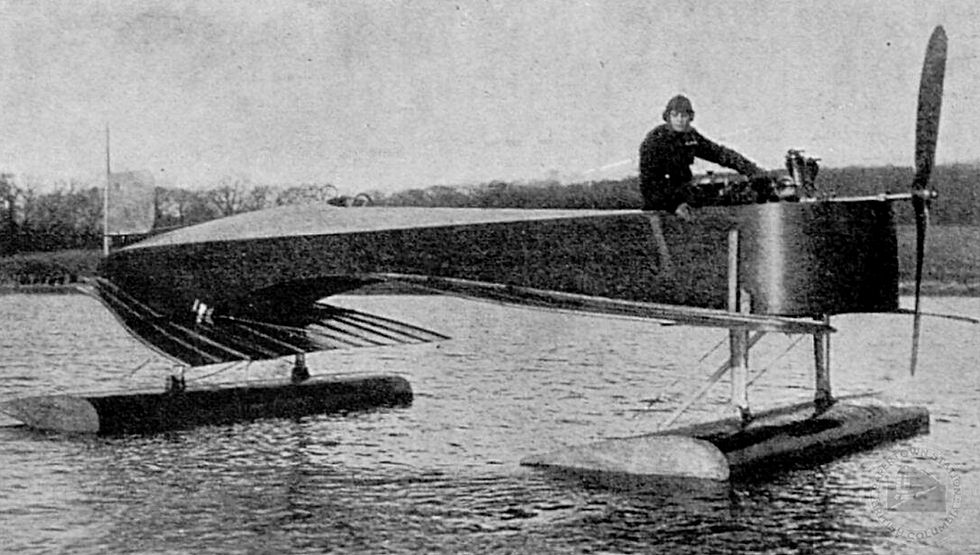
“1911::The ‘Bird-Boat’—An Early Aero-Hydroplane Design”
Newspaper clipping: The Graphic (1910)
London, England
The story of the Mars aircraft is deeply rooted in the birth of aviation, when world powers believed that if a flying machine could land on water, it could cross an ocean (such power could rule the airways). Many of the world’s earliest aviators performed record-breaking feats with such machines, and at the helm of many of these innovations was amateur birdman Glen Luther Martin.

"1913::Glen L. Martin Takes James Irvine For a Ride in His World Record-Breaking Hydro-Aeroplane"
Photograph: Unknown photographer (c. 1913)
Martin was a young automobile salesman from Santa Ana, California, whose daring flights in his self-made flying machines made him a small-town celebrity. In 1911, he became California’s first aviator to qualify for an international pilot license in a machine he had built himself. Several months later, he garnered worldwide attention when he flew his newly constructed hydro-aeroplane from Balboa to Santa Catalina Island, claiming the world’s longest cross-water flight—a record previously set by Frenchman Louis Blériot in 1909, when he crossed the English Channel.

"1913::James Irvine and Glen L. Martin Aboard His World Record-Breaking Hydro-Aeroplane" Newspaper clipping: Santa Ana Register (1939)
Santa Ana, California
The feat caught the attention of the U.S. Navy, and within three years of his first flight over California’s ranch fields, Martin was designing military aircraft on a large scale. To mark the second anniversary of his famous flight, he invited James Irvine, owner of the San Joaquin Ranch where he had taught himself to fly, to join him as a passenger and view the ranch from above.
"Wonderful! Remarkable! It appeared as if some invisible braces were holding the machine in the air, so steady and solid, yet springy, did it ride." — James Irvine, owner of the San Joaquin Ranch (after his first flight with Martin)

"1941::To Europe and Back on a Single Tank of Fuel"
Newspaper clipping: Public Opinion (1941)
Chambersburg, Pennsylvania
Nearly three decades later, in 1941—just weeks before the Japanese attack on Pearl Harbour in Hawaii—Martin unveiled his first large-scale flying boat for the US Navy and christened it the Martin Mars, named after the Roman god of war. The Mars was designed as a long-range, high-altitude bomber, but within a few months of service it became evident that the massive aircraft was more valuable for its cargo and personnel capabilities. The US Navy grounded its new plane and had it reconstructed for long-range transport duties. Several months later, the Mars returned to the air and shattered world transport records.

“1942::The Martin Mars on Its Maiden Flight with a Grumman Fighter Escort”
Magazine clipping: The Sphere (1942)
London, England
Within its first year, the Martin Mars set aviation standards that were once considered futuristic and unattainable. With its ability to fly to Europe and back on a single tank of fuel and encircle the globe with just five fuel stops it was the most capable long-range aircraft in its time. Impressed by such performance, the US Navy ordered the production of 20 additional Mars aircraft to aid in cargo and troop-carrying operations in the South Pacific. Glen L. Martin modelled these new planes on the smaller 1941 prototype, the Martin Mars.

"1945::The Hawaii Mars Slides Into the Water for the First Time"
Newspaper clipping: Hanford Morning Journal (1945)
Hanford, California
On July 21, 1945, the Hawaii Mars became the first of 20 Mars aircraft built for the U.S. Navy, with an official christening in the presence of its designer, Glen L. Martin. Just two weeks later, as the B-29 bomber Enola Gay flew toward Hiroshima, Japan—marking the beginning of the atomic age—the Hawaii Mars crashed in Chesapeake Bay during its first test landing.

“1945::Tail and Fuselage of the Hawaii Mars Raised from the Chesapeake Bay for Salvage”
Newspaper clipping: The Daily Sentinel-Tribune (1945)
Bowling Green, Ohio
Although the aircraft was quickly recovered and used for parts, the US Navy used the event to reduce its order from 20 Mars aircraft to 11. The order was further reduced to five when, two days later, a second atomic bomb was dropped on Nagasaki, Japan, confirming that the war’s end was near.

"1946::The Last of Six (Including Hawaii Mars)"
Newspaper clipping: The Sun (1946)
Baltimore, Maryland
Within the following year, all five Mars aircraft—the Philippine Mars, Marianas Mars, Marshall Mars, Hawaii Mars II, and Caroline Mars—were launched and named after the South Pacific islands where scenes of World War II combat had occurred.

“1950::The Crash of the Marshall Mars”
Magazine clipping: The Sphere (1950)
London, England
In 1950, on a routine flight, the Marshall Mars made an emergency landing after one of its engines caught fire. The crew escaped without injury before a series of small explosions burned the aircraft to the waterline. After a brief service life marked by numerous transport records, the Marshall Mars sank, reducing the Mars fleet to four aircraft. In 2004, the wreck of the Marshall Mars was discovered on the ocean floor just outside Hawaii’s Keʻehi Lagoon, where the remaining Martin Mars flying boats were based.

“1959::Marianas Mars — First of Four to Arrive at Patricia Bay”
Newspaper clipping: Victoria Daily Times (1959)
Victoria, British Columbia
Years after the Second World War, a select few Canadian pilots traded in their Lancasters for a very different kind of bomber. They joined British Columbia’s Forest Industries Flying Tankers (FIFT), which had rescued the world-famous Mars flying boats from a California scrapyard. The massive aircraft had been sent there in 1956, shortly after the Vancouver Island company had failed to acquire the entire fleet from their Hawaiian custodians.

"1959::The Mars Project Sponsors"
Newspaper clipping: Daily Free Press (1959)
Nanaimo, British Columbia
In 1959, however, with a new deal finally in place, the remaining Mars fleet was brought to Vancouver Island to be repurposed. FIFT engineers believed that these aircraft, previously used for cargo and passenger service, could become the largest and most efficient fire-fighting aircraft in the world. Many pilots agreed and moved to Vancouver Island to join the team tasked with converting the fleet into water-scooping machines.

“1960::The First Mars Water Bomber Test Flight — Sidney, British Columbia”
Photograph: Jim Ryan, The Vancouver Sun (1960)
Vancouver, British Columbia
By 1960, the first Martin Mars water bomber was ready for its first test flight. From the shores of Sidney, British Columbia, reporters and onlookers watched as the aircraft skimmed the ocean’s surface at 75 mph and scooped as much as 7,000 gallons of water. This was ten times more water than the smaller craft used for firefighting at the time. With a full load, the aircraft’s four crew returned and released the water within view of the awed spectators. Some called it a “logger’s dream,” as it was apparent that this new plane meant an end to hauling hose from the nearest lake to an unpredictable and often unreachable forest fire. The test flight was an enormous success. In the years that followed, however, two of the pioneer test pilots who had helped convert the massive plane into a water bomber would later perish fighting the very fires they had set out to battle.

"1961::The Crash of the Marianas Mars"
Newspaper clipping: Daily Free Press (1961)
Nanaimo, British Columbia
Only one Mars aircraft—the Marianas Mars—had been converted for the trial run. Engineers hoped that if it could prove its worth in its first year, they could convert the remaining three planes for water bomber service. In its first fire season, the Marianas Mars fought fires in a way that had never been seen before and proved itself worthy of repurposing. However, as the first anniversary of its Sidney test flight approached, the Marianas Mars crashed near Englishman River Falls on Vancouver Island while battling a fire.

"1961::The Verdict"
Newspaper clipping: The Daily Free Press (1961)
Nanaimo, British Columbia
Witnesses claimed that the pilots were flying too low and had held back their water drop after seeing men on the ground below. Fearing they might hit them with the drop, they flew past their target area and failed to clear a tree while attempting to turn back, crashing on the mountainside. All four crew members of the Marianas Mars perished in that flight, including one of its original test pilots.

“1962::The Wreck of the Caroline Mars at Patricia Bay Airport, Vancouver Island”
Newspaper clipping: The Vancouver Sun (1962)
Vancouver, British Columbia
The Mars water bomber project remained in limbo for several months after the Marianas Mars tragedy at Englishman River Falls. Ultimately, however, after weighing the enormous benefit that the Marianas had brought to British Columbia in its short year of service, the decision to continue with the conversion of the remaining three planes was worth the risk. The conversion of the Philippine, Hawaii Mars II, and Caroline continued. But on October 13, 1962, tragedy struck the Mars fleet again.

"1962::Typhoon Frieda"
Newspaper clipping: The Sun (1962)
Vancouver, British Columbia
Just months after the Caroline Mars was successfully converted into a water bomber, a powerful Pacific storm hit Vancouver Island. Typhoon Frieda had cut a path of destruction as it moved north along the Pacific coast before crossing the island’s southern tip. The Caroline Mars, thought to be safely secured at Patricia Bay Airport, fell victim to Frieda’s wrath when a strong gust ripped the massive plane from its steel mooring cables and hurled it into the air. The Caroline Mars lay in ruin on the tarmac of Patricia Bay Airport and was eventually dismantled for parts.

"1962::Sproat Lake Homebase"
Photograph: Private collection (2005, courtesy of A.P., used with permission)
Sproat Lake, British Columbia
The remaining two water bombers of the dwindling Mars fleet, the Philippine and Hawaii Mars II, were given a fresh coat of red and white paint before being sent into action from their new home at Sproat Lake near Port Alberni, Vancouver Island. From there, the two planes and their crews spent the next several decades fighting BC forest fires and assisting in major fire incidents along the Pacific Coast.

“1967::The Tragedy of the Flying Firemen”
Newspaper clipping: Victoria Daily Times (1967)
Victoria, British Columbia
Several years later, a company called The Flying Firemen was developed using Canso planes. It was the brainchild of one of the pioneer test pilots of the Marianas Mars. Business was going well for the pilot who, by 1967, had several aircraft fighting fires throughout British Columbia. That summer was a hot one though, and by July, nearly 300 fires were raging—23 on the Island and Lower Mainland alone. All were under control except one. The fire on Skirt Mountain in Victoria, British Columbia, began on a Sunday afternoon and spread rapidly. The Flying Firemen were called in to help while hundreds of spectators gathered in the Goldstream and Millstream neighbourhoods at the base of the mountain. People cheered and snapped photos as the Flying Firemen’s Canso approached the fiery mountaintop with its water dump. To their horror, however, the plane suddenly disappeared into the smoke—and a fireball lit up the sky.

"1967::Tragedy On Skirt Mountain"
Newspaper clipping: Victoria Daily Times (1967)
Victoria, British Columbia
Both pilots perished in the crash, including the Marianas Mars pioneer test pilot in his own Canso plane. It was to have been his last flight of the day. A Mars water bomber was called into service when the crash reignited the mountainside fire, causing it to burn out of control. Days passed before the fire finally began to smoulder. Eyewitnesses later gave their accounts and shared photos of the pioneer pilot’s Canso in its final moments.
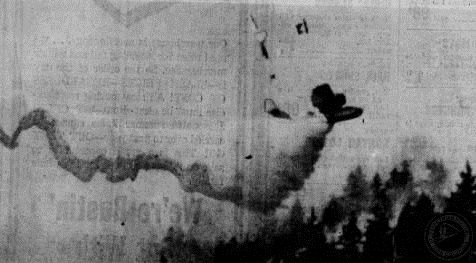
"1967::Flying Firemen Crash"
Newspaper clipping: Victoria Daily Times (1967)
Victoria, British Columbia
Some said the plane’s wing struck a tree, while others claimed they saw one of the wings disintegrate before the aircraft disappeared into the smoke. One year later, a similar crash occurred nearby in the Sooke Hills when two more firefighting pilots lost their lives. In a cruel twist, one of the pilots killed in that crash had originally been scheduled to fly on the Skirt Mountain mission the year before, but had been replaced at the last minute.

“2022::The Flying Firemen Memorial Park”
Photograph: Private collection (2022, courtesy of A.P., used with permission)
Langford, British Columbia
The two remaining Mars water bombers—the Hawaii Mars II and the Philippine Mars—served for many years from their base at Sproat Lake on Vancouver Island. In 2022, a new neighbourhood was developed on Skirt Mountain, and a park was dedicated to the firefighting pilots who had perished in the Skirt Mountain crash.

“2024::The Last Flight of the Hawaii Mars II and its Canadian Forces Snowbirds Escort”
Photograph: Private collection (2024, courtesy of J. Carlos, used with permission)
On August 11, 2024, the Hawaii Mars II set out on its final flight. Its destination was the British Columbia Aviation Museum in Sidney, British Columbia. Vancouver Islanders came out by the thousands to bid their old friend a fond and bittersweet farewell, just as Hawaiians had done before them in 1956. The plane’s final flight path ensured that those who had come to love and appreciate the Mars water bombers and the pilots who flew them had one last chance to wave goodbye. With a Canadian Forces Snowbirds escort, the Hawaii Mars II flew majestically along the island’s coast and safely landed in the Saanich Inlet, back to where its Vancouver Island story began in 1959. There, it will represent the legacy of the Mars fleet and enjoy retirement after almost 70 years of faithful service.
“2024::The Philippine Mars Over Qualicum Beach, Vancouver Island”
Video: Private collection (2024, courtesy of Nick Acciavatti, used with permission)
Shortly before noon on December 15, 2024, the Philippine Mars, the last of these old Martin Mars aircraft, set out on its final journey from Sproat Lake to its new forever home in Pima, Arizona’s Air & Space Museum. In freshly restored US Navy colours, the massive plane flew proudly southward over several Vancouver Island communities toward its well-deserved retirement in Arizona. But as it passed the southernmost tip of Vancouver Island, it became clear that the Philippine Mars didn’t want to leave.

“2024::The Philippine Mars Forced to Land Safely in Patricia Bay During Last Flight”
Photograph: Private collection (2024, courtesy of Jen Wright, used with permission)
While in flight, the Philippine Mars experienced a problem with one of its engines and was forced to land safely in Patricia Bay. It came to rest near its retired sister ship, the Hawaii Mars II, until further assessment could be made. On January 6, 2025, it was flown back to its home base at Sproat Lake, Vancouver Island, where its engine was repaired.
“2025::The Philippine Mars Begins Its Last Flight Out of Sproat Lake, Vancouver Island”
Video: Private collection (2025, courtesy of J. Linning, used with permission)
On Sunday, February 9, 2025, the Philippine Mars set out once more on its final flight to its forever home in Pima, Arizona. The occasion marked the end of the Mars water bomber era on Vancouver Island and the final chapter of the Martin Mars worldwide.
Story Timeframe: c. 1941–2025
Sources are credited where known. Historical materials are reproduced for research, commentary, and education, with digitized materials sourced from archival collections including Newspapers.com, the British Newspaper Archive, the British Colonist (University of Victoria) and other digital repositories, including wire service images such as the Associated Press, credited where known. Images have been cropped and enhanced for clarity where necessary.


